Many Christians nowadays would point to Christmas as the main festival in the church year. In medieval times, Easter was seen as equally important and was one of the most exhilarating and memorable days of the year.

For medieval Christians, Easter was particularly enjoyable because it came after six weeks of hard fasting and abstinence. Beginning on Ash Wednesday, when churchgoers were marked with ashes, Lent was a time when everyone, rich and poor, was expected to forgo many everyday pleasures.
The emphasis was on sacrifice and even commonplace foods such as eggs and meat had to be saved until the Easter celebrations. Eggs laid during the Lenten period were hardboiled to preserve them, a tradition which continues today in the painting of hardboiled eggs.
The Lenten observances came to a climax during Holy Week, the week before Easter. There were daily church services, but thoughts of Easter applied also to everyday life, with an old tradition forbidding anyone to use nails or iron tools on Good Friday, to commemorate Jesus on the cross.
Good Friday was the day for the ceremony of creeping to the cross, when churchgoers would approach the crucifix on bended knee, or barefoot.
Medieval Easter Day Rituals and Traditions
The dawning of Easter Day was special and memorable for medieval people, with many gathering before dawn to watch the sun rise. Members of each parish would stand near the church and sing hymns as the sun slowly rose and church bells rang out. After greeting the first rays, they would be led to church by the parish priest, singing hymns of joy as they went.
As well as the church’s celebrations, Easter Day was a day for pleasure and fun after six weeks of fasting. Anyone who could afford it, would wear a new set of clothes on Easter Sunday. For many, this could be the only time of year they got a new item of clothing.
Children were involved in the fun, with parents hiding hard boiled eggs as a symbol of the apostles finding the risen Christ in the tomb, and there would be egg rolling and parades.
For many, the main thing to look forward to was that Easter Sunday was one of the few days in the year when no one had to work. It was traditional for servants to present their lord with a small gift, perhaps a dish of food or a new-born animal, and in return, the lord would provide a feast for his servants and their families.
For the wealthier sections of society, the Medieval Easter Court was a time to re-establish friendships, cement business relationships and join their peers at a sumptuous feast, a feast which contained all the foods which had been banned during Lent.
The fun didn’t stop after Easter Sunday. Hock Monday and Hock Tuesday were a chance for the younger people of a town or village to release their high spirits after weeks of fasting. Hock Monday was the day when girls could capture the boys of the area, releasing them only on payment of a donation to church funds. Tuesday was the turn of the boys to capture any girls they saw passing by.
These rituals and celebrations were followed year after year in Christian countries, with each district or country putting its own personal flavour on proceedings, ensuring that the festivities were a real
Easter Symbols
Ancient Spring GoddessAccording to the Venerable Bede, Easter derives its name from Eostre, an Anglo-Saxon goddess of spring. A month corresponding to April had been named "Eostremonat" or Eostre's month, leading to "Easter" becoming applied to the Christian holiday that usually took place within it. Prior to that, the holiday had been called Pasch (Passover), which remains its name in most non-English languages.
It seems probable that around the second century A.D., Christian missionaries seeking to convert the tribes of northern

Easter Eggs
In Medieval Europe, eggs were forbidden during Lent. Eggs laid during that time were often boiled or otherwise preserved. Eggs were thus a mainstay of Easter meals, and a prized Easter gift for children and servants.
In addition, eggs have been viewed as symbols of new life and fertility through the ages. It is believed that for this reason many ancient cultures, including the Ancient Egyptians, Persians, and Romans, used eggs during their spring festivals.
Sources:
www.wikipedia.com
www.infopedia.pt
www.suite101.com
www.infoplease.com
Books were extremely rare during the Middle Ages. The few that existed were generally hand copies that monks or other writers made with much difficulty. Reading was truly reserved for the nobility as books were so limited.
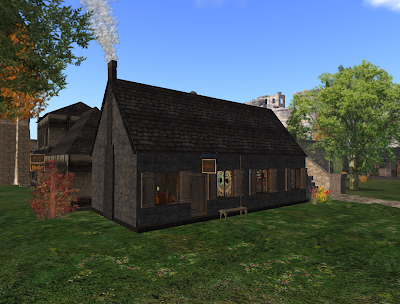
The most common language for medieval works was Latin because the church was virtually the only educational institution. There were a few copies of works in Old English, German, and more but these languages were not consistent as writers wrote what they heard rather than follow grammatical rules.
During the Middle Ages, language was changed and improved. Capital letters were first employed and much of the grammatical syntax in use today first appeared.
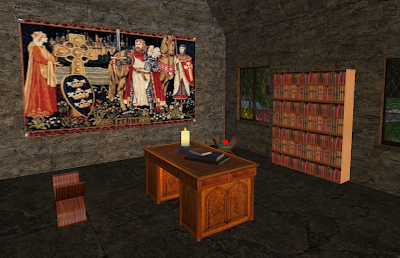
In 1440, almost at the end of the Medieval Ages, the German Johannes Gutenberg invented the first printing press in Europe. Within a few decades, books and papers that had previously taken months or years to write by hand were copied within hours. This is one of the reasons why during the Renaissance there was more literature compared to the Middle Ages.

We have our own little Library in the heart of Duhallow, where one can find books about the History of the Realm of Fayandria. Do pay a visit to the library for it is a quiet and peaceful place where you can unwind and perhaps deepen your knowledge about the Realm of Fayandria social structure, or about the McDunnough Clan or even about Embersray.
May I also suggest a visit to the World Digital Library. It took four years to build and it is recently available to everyone in the World, since April 21st - the World Digital Library will make available on the Internet, free of charge and in multilingual format, significant primary materials from cultures around the world, including manuscripts, maps, rare books, musical scores, recordings, films, prints, photographs, architectural drawings, and other significant cultural materials. The objectives of the World Digital Library are to promote international and inter-cultural understanding and awareness, provide resources to educators, expand non-English and non-Western content on the Internet, and to contribute to scholarly research.
Happy readings, my friends…

Greetings Fayandrians!
This is a new Column. Weekly, I will post some interesting stories, tales, food and others medieval related. I hope you enjoy reading them!
Inns & Taverns
Inns appeared in England in the twelfth and thirteenth centuries, and were apparently fairly common, especially in towns, by the fifteenth century. The earliest buildings still standing today, such as New Inn, Gloucester, or King's Head, Aylesbury, date from this time. While inns provided lodgings for travellers, taverns were drinking houses seeking to cater for the more prosperous levels of society. The leading taverners in larger towns were themselves vintners or acted as agents for vintners. The Vintner's Company of London, for instance, secured an essential monopoly of the retail trade in the city in 1364. A tavern of the later Medieval period might be imagined as a fairly substantial building of several rooms and a generous cellar. Taverns had signs to advertise their presence to potential customers, and branches and leaves would be hung over the door to give notice that wine could be purchased. Some taverns sold wine as their only beverage, and a customer could also purchase food brought in from a convenient cook-shop. Taverns seldom offered lodgings or very elaborate feasting, such as would be expected at inns.

The favourite adult recreation of the villagers was undoubtedly drinking. Both men and women gathered in the "tavern," usually meaning the house of a neighbour who had recently brewed a batch of ale, cheap at the established price of three gallons for a penny. There they passed the evening like modern villagers visiting the local pub. Accidents, quarrels, and acts of violence sometimes followed a session of drinking, in the thirteenth century as well as subsequent ones. Some misadventures may be deduced from the terse manorial court records. The rolls of the royal coroners, reporting fatal accidents, spell out many in graphic detail: In 1276 in Elstow, Osbert le Wuayl, son of William Cristmasse, coming home at about midnight "Drunk and disgustingly over-fed," after an evening in Bedford, fell and struck his head fatally on a stone "breaking the whole of his head." One man stumbled off his horse riding home from the tavern; another fell into a well in the marketplace and drowned; a third, relieving himself in a pond, fell in; still another, carrying a pot of ale down the village street, was bitten by a dog, tripped while picking up a stone to throw, and struck his head against a wall; a child slipped from her drunken mother's lap into a pan of hot milk on the hearth. One village craft was so widely practiced that it hardly belonged to craftsmen. Every village not only had its brewers, but had them all up and down the street. Many if not most of them were women. Ale was as necessary to life in an English medieval village as bread, but where flour-grinding and bread-baking were strictly guarded seigniorial monopolies, brewing was everywhere freely permitted and freely practiced. How the lords came to overlook this active branch of industry is a mystery (though they found a way to profit from it by fining the brewers for weak ale or faulty measure). Not only barley (etymologically related to beer) but oats and wheat were used, along with malt, as principal ingredients. The procedure was to make a batch of ale, display a sign, and turn one's house into a temporary tavern. Some equipment was needed, principally a large cauldron, but this did not prevent poor women from brewing. All twenty-three persons indicted by Elton village ale tasters in 1279 were women. Seven were pardoned because they were poor.
Relay for Life of Second Life